How to Walk With a Human Guide Safely and Comfortably

Editorial guide

How to Walk With a Human Guide Safely and Comfortably

A good human guide does not drag you forward. The two of you move as a small system where arm position, spacing, and early communication make route changes easier to feel before they become surprises.

Reader route
Best for Readers, families, and instructors
Use this page to Get oriented before going deeper
Next move Open related guides and checklists
Published May 20, 2026
Briefing

A lot of awkward guided walking starts with people trying to be helpful in ways that feel natural to them but do not actually give the blind traveler useful information. Hand-pulling, shoulder-grabbing, and side-by-side crowding usually create less control, not more.

The better approach is simple: use one clear arm hold, one reliable body position, and enough communication that the route feels readable instead of rushed. That turns guided walking into a practical O&M skill rather than a social guess.

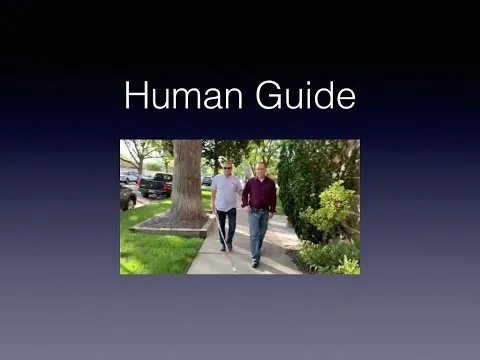
Walking with a Human Guide

What does ahuman guidedo, and how can they help somebody with a visual impairment navigate the world? Learn all about the ...

  • Channel: Braille Institute

Video source: Braille Institute

Rapid read

Key takeaways

  • 01The safest default is usually an elbow-level hold with the traveler walking slightly behind the guide, not clinging to a hand or shoulder.
  • 02Half-step spacing matters because it gives earlier warning about turns, curbs, stairs, and narrow places.
  • 03A good guide relationship depends on communication about pace, comfort, and route changes before the body has to react at the last second.
01

Start with the arm position that gives real feedback

The most useful starting position is usually to hold the guide's arm just above the elbow with a firm but relaxed grip. That spot lets the guide's shoulder and torso movement travel down the arm, so turns and slowdowns show up earlier in your hand.

By contrast, holding hands or resting on a shoulder tends to flatten that feedback. It can also make the guide overcompensate, which turns the walk into pulling and steering instead of shared movement.

  • 01Keep your thumb on the outside and your fingers around the arm in a comfortable grip.
  • 02Use enough pressure to stay connected, but not so much that the guide feels pinned.
  • 03If you use a cane, keep the cane in your free hand unless a specific route setup calls for something different.
How to Walk With a Human Guide Safely and Comfortably
02

Stay half a step behind instead of shoulder to shoulder

Walking slightly behind the guide gives you a moment of extra warning. When the guide slows, turns, narrows their body for a doorway, or lines up for a curb, you feel that change before your own body reaches the same point.

spacing also reduces crowding. When people walk directly side by side, small route changes can become elbow bumps and foot tangles instead of clear directional information.

  • 01Think of the spacing as reaction time, not as a social distance rule.
  • 02Keep your guiding elbow near your side so the body line stays stable.
  • 03If the position starts to collapse into side-by-side walking, reset before the next obstacle.
How to Walk With a Human Guide Safely and Comfortably
03

Talk about pace early instead of enduring a bad rhythm

A guide who walks too fast can make even a simple route feel tense. A guide who slows unpredictably can be just as annoying. The fix is not heroic tolerance. It is direct communication before the mismatch gets worse.

Pace usually improves when both people treat it as shared route information, not a personal criticism. A short note like 'a little slower' or 'hold this pace' is often enough.

  • 01Say when the pace is too fast before you start lagging or stumbling.
  • 02Use the same route twice if needed so the guide can learn your comfortable rhythm.
  • 03Slow down sooner when the route gets noisy, crowded, or uneven.
04

Handle curbs, stairs, and narrow spaces as clear transitions

Curbs and stairs usually feel cleaner when the guide approaches them straight on instead of drifting in diagonally. That makes the edge easier to predict in relation to your own body and foot placement.

Narrow spaces also work better when the guide signals them early and changes body position in a way you can feel. The important idea is not memorizing fancy choreography. It is making the transition readable before you enter it.

  • 01Approach steps and curbs head-on when possible.
  • 02Do not wait until the doorway or stair is already underfoot to mention it.
  • 03Treat each narrowing, step, or curb as a cue to slow down and re-sync.
05

Practice the technique on short familiar routes first

Good human-guide travel usually feels smoother after repetition, not after one explanation. A short walk to the mailbox, a store entrance, or a familiar hallway gives both people enough repetition to notice what is working and what is still awkward.

practice matters because guided travel is partly physical timing. It becomes easier when both people learn the same rhythm instead of trying to solve every issue in a crowded public setting.

  • 01Start with a route simple enough that you can focus on technique.
  • 02Reset the hold or spacing if it drifts instead of pushing through sloppy form.
  • 03Use repetition to make the technique calmer, not just faster.
06

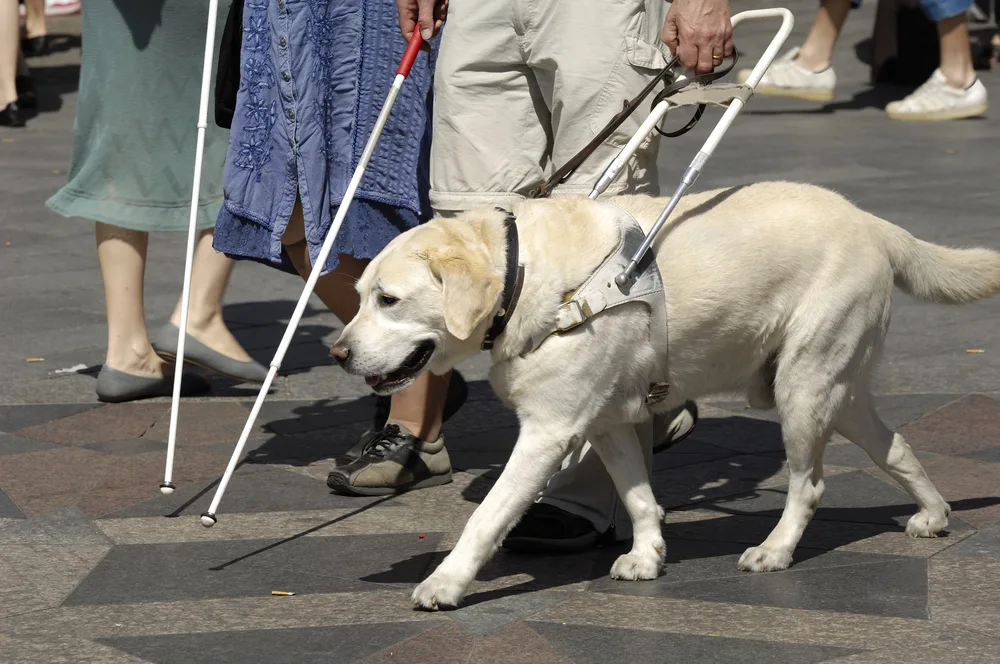
Remember that guide dogs still depend on mobility basics

Some travelers eventually use a guide dog, but that does not erase the need for orientation and mobility skills. Route judgment, body alignment, and communication still matter because the traveler remains responsible for reading the situation and making decisions.

is why human-guide technique is worth learning well even if your long-term mobility setup may change. Clean fundamentals transfer better than improvised habits.

  • 01Do not treat a guide dog as a substitute for mobility basics.
  • 02Keep building route judgment, spacing awareness, and communication skills.
  • 03Ask for O&M instruction if guided travel keeps feeling confusing or physically awkward.

FAQ

Frequently asked questions

01Where should you hold a human guide while walking?

The usual starting point is just above the guide's elbow. That position gives better movement feedback than holding a hand or resting on a shoulder, and it makes turns and slowdowns easier to feel early.

02Why walk half a step behind a human guide?

slight offset gives you reaction time. You feel the guide's movement first, then your body reaches the same doorway, curb, stair, or turn a moment later, which makes the route easier to read.

03What should you do if the guide walks too fast?

Say so directly and early. Guided walking is supposed to be usable, not polite suffering. A simple request to slow down usually fixes the problem faster than trying to keep up until the whole walk feels stressful.

04Can human-guide travel replace orientation and mobility training?

No. It can help on specific routes or in unfamiliar settings, but it does not replace the broader skills of route judgment, alignment, hazard awareness, and independent travel decision-making.